June 9, 2026 • Tomás Guerreiro • 9 min reading time • Specs verified June 18, 2026
Rachio 3 vs. Hunter Hydrawise vs. Rain Bird ESP-TM2: Which Smart Controller Actually Earns Its Weather Intelligence?

A smart irrigation controller is the brain of your sprinkler system — it decides when to water, for how long, and whether to skip a scheduled run because rain is coming. Unlike a basic timer that waters on a fixed schedule no matter what the weather does, a smart controller pulls in local weather data and adjusts automatically, which is where the real water savings originate. If you’re choosing between the Rachio 3, Hunter Hydrawise (running on the Pro-HC hardware platform for most professional installs), and the Rain Bird ESP-TM2, you’re comparing three genuinely capable systems built around different philosophies for different operators. This article breaks down exactly where they differ, what those differences cost in real money, and which one makes sense for your situation right now.
The Weather Engine: How Each Controller Actually “Thinks”
This is the core question, and the answer is more nuanced than any marketing copy suggests.
Rachio 3: Hyperlocal and Autonomous
Rachio 3 runs on what Rachio calls Weather Intelligence Plus — a proprietary algorithm that pulls hyperlocal data from a network of personal weather stations (primarily Weather Underground) combined with satellite precipitation estimates. It calculates ET (evapotranspiration) — the rate at which your landscape loses water to evaporation and plant transpiration — and adjusts run times dynamically. Per Rachio’s published developer documentation, the system supports true daily ET-based scheduling, not just rain-skip logic. Family Handyman’s 2024 smart irrigation controller review consistently places the Rachio 3 as the top pick for homeowners who want weather-adaptive scheduling that runs without manual recalibration season to season.
Rachio
$199.00
In stock on Amazon
Check price on AmazonHunter Pro-HC with Hydrawise: Predictive and Fleet-Ready
Hunter Hydrawise — the software layer that powers the Hunter Pro-HC controller — uses a weather intelligence model built around localized ET data sourced from a global weather network. The meaningful difference from Rachio is Hydrawise’s emphasis on predictive flow management: it factors in forecast data up to 14 days out, which matters when you’re managing large turf zones where watering a day early before a half-inch of rain is genuinely expensive. The Irrigation Association’s 2023 Smart Controller Performance Testing Summary found that ET-based controllers with multi-day forecast integration consistently outperformed rain-sensor-only systems on measurable water savings — and that multi-day forecast architecture is central to how Hydrawise is designed.
Rachio
$249.00
In stock on Amazon
Check price on AmazonRain Bird ESP-TM2: Reliable, Field-Serviceable, WaterSense Certified
Rain Bird ESP-TM2 is WaterSense certified by the EPA (EPA WaterSense, “WaterSense Labeled Controllers,” program specification overview, 2024) and supports ET-based scheduling, but its native weather intelligence depends more heavily on the Rain Bird LNK WiFi module — an add-on, not included in the base unit — connecting to Rain Bird’s cloud service. This Old House’s 2025 editorial review of smart sprinkler controllers notes that the ESP-TM2’s weather intelligence is solid but performs best when paired with a properly configured flow sensor and a nearby weather station rather than relying solely on cloud-sourced data. Where it genuinely leads: on-box programming flexibility and commercial-grade hardware reliability for contractors who need technicians to troubleshoot a system in the field without a phone.
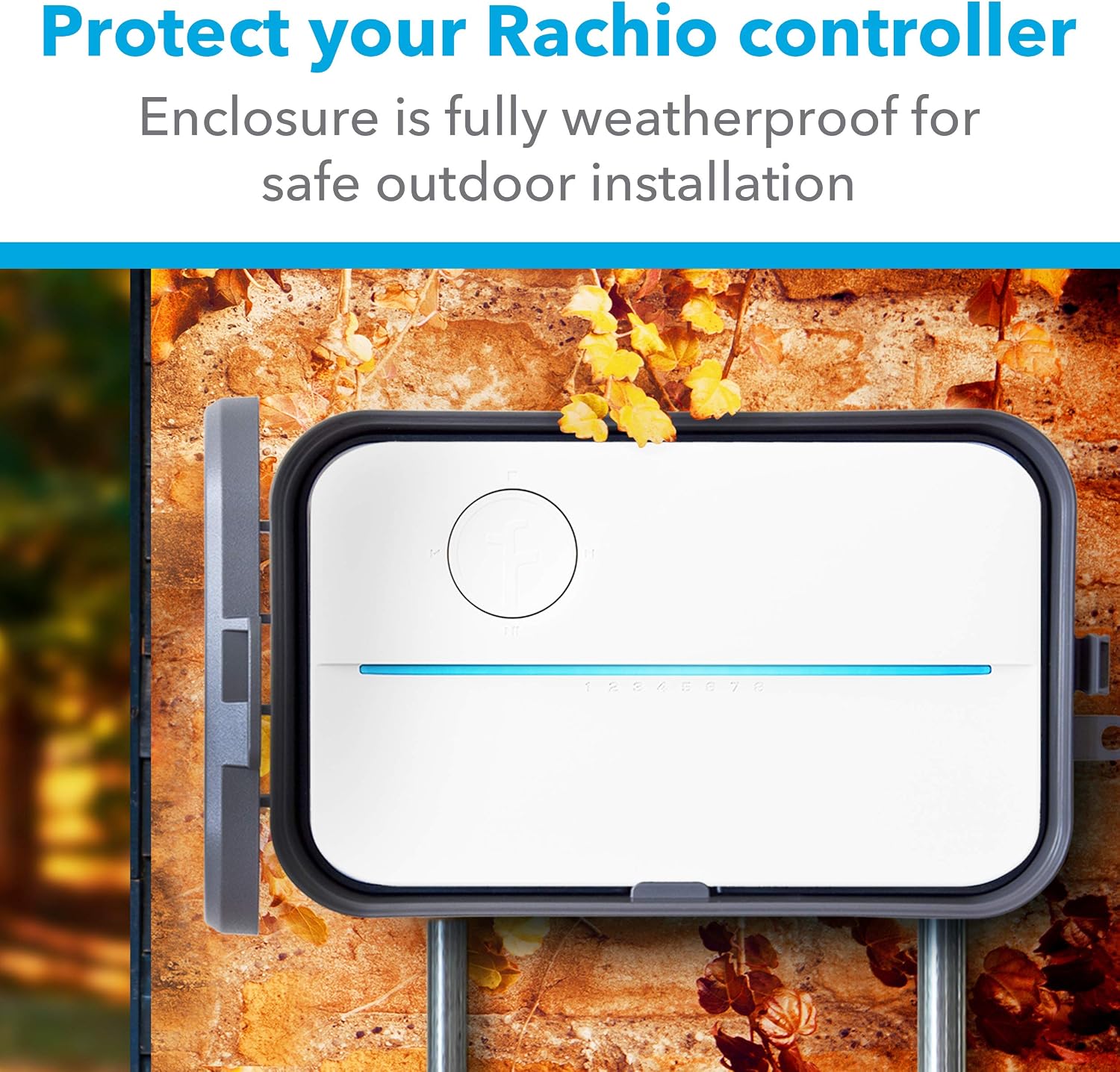
Rachio
$35.99
In stock on Amazon
Check price on AmazonZone Capacity, Expansion, and the Multi-Property Reality
If you’re managing more than one property or speccing a system with 12 or more zones, the controller’s architecture matters as much as its weather engine.
Rachio 3: Right-Sized for Residential
The Rachio 3 is available in 8-zone and 16-zone configurations, and 16 zones is the hard ceiling for a single unit — there is no expansion module path beyond that. The system is also cloud-dependent for its weather intelligence to function fully. If WiFi drops, it falls back to a fixed schedule — not catastrophic for a homeowner, but a callback risk on commercial installs. Operators managing boutique properties or HOA common areas frequently note this limitation in long-run reviews. For a single residential property with up to 16 zones, this architecture is rarely a constraint.
Rachio
$199.00
In stock on Amazon
Check price on AmazonHunter Pro-HC with Hydrawise: Scales Without Compromise
Hunter Pro-HC with Hydrawise scales cleanly to 48 zones through expansion modules and maintains full local operation when internet is unavailable. For a landscape contractor managing 8 to 15 residential accounts, or a property manager with a clubhouse plus three outlying turf zones, that offline reliability is a legitimate differentiator. The Hydrawise contractor portal also allows managing all client sites from a single login, setting flow anomaly alerts, and adjusting schedules across multiple properties simultaneously — a capability This Old House’s 2025 editorial review identified as a meaningful step above the competition for professional operators.
Rachio
$249.00
In stock on Amazon
Check price on AmazonRain Bird ESP-TM2: Light-Commercial Sweet Spot
Rain Bird ESP-TM2’s modularity up to 22 zones hits a sweet spot for light-commercial single-property installs — a mid-size commercial property, a school athletic field, or a large residential estate. Its local program storage is robust, and its hardware platform is the most widely understood by field technicians across the irrigation industry. UC ANR’s “Landscape Irrigation Scheduling and Water Management” (University of California Agriculture and Natural Resources, 2022) emphasizes that the operational reliability of scheduling hardware — not just its intelligence layer — directly affects whether ET-based savings are maintained year over year. That’s the argument for ESP-TM2 in commercial contexts: it’s the platform least likely to generate a service call from a hardware failure.
Rachio
$35.99
In stock on Amazon
Check price on AmazonThe Real Cost Comparison
Let’s run the numbers on what each platform actually costs to own at a real-world install level. Pricing below reflects 2026 market conditions at professional irrigation supply distributors.
Rachio 3: No Subscription, Hard Ceiling at 16 Zones
- Rachio 3 (16-zone): approximately $280–$310 retail
- Flow sensor add-on: approximately $50
- Annual subscription: none
The Rachio 3 carries no annual subscription fee, which is a genuine long-term cost advantage. The constraint is structural: operators managing more than 16 zones need a second unit, and at $280-plus each, that stacks quickly compared to Hunter’s module-based expansion path.
Rachio
$199.00
In stock on Amazon
Check price on AmazonHunter Pro-HC with Hydrawise: Subscription Cost Is a Line Item, Not a Dealbreaker
- Hunter Pro-HC (12-zone base): approximately $220–$260
- Hydrawise subscription: free tier available; Pro tier approximately $60 per year
- Flow modules: included in commercial configurations
At the $1,500 to $5,000 project level, the Hydrawise Pro subscription is a line item, not a decision point. The module-based expansion to 48 zones makes it the only platform here that grows with a contractor’s book of business without forcing a hardware rearchitecture.
Rachio
$249.00
In stock on Amazon
Check price on AmazonRain Bird ESP-TM2: Attractive Box Price, Real Add-On Costs
- Rain Bird ESP-TM2 (12-zone): approximately $175–$220
- LNK WiFi module (required for smart features): approximately $80–$100
- Flow sensor: approximately $85–$120
The real cost trap: adding the LNK module, a flow sensor, and a compatible weather station brings the all-in ESP-TM2 cost to within $30–$50 of a Rachio 3 or Hunter Pro-HC — without the same native integration depth. That said, contractors sourcing at volume through established distributor relationships regularly negotiate pricing that reshapes this math. For operators already standardized on Rain Bird valves and rotor hardware, the ecosystem continuity has real value that the hardware-only price comparison doesn’t capture.
UC ANR’s landscape irrigation scheduling guidelines consistently note that the ROI on any smart controller comes from reducing over-irrigation, not from the hardware cost differential alone. A controller that saves 20 to 30 percent on water bills on a 12-zone commercial property running $150 per month in irrigation costs pays for itself within 6 to 12 months — the platform choice affects how reliably those savings are maintained year over year, not whether savings are theoretically possible.
Rachio
$35.99
In stock on Amazon
Check price on AmazonThe App and Remote Management Experience
For a single homeowner with one property, app quality is a convenience question. For a contractor managing 15 accounts, it is an operational question.
Rachio 3 has the strongest consumer app reputation in aggregated user reviews — clean interface, reliable push notifications, and a genuinely useful water usage history dashboard that makes it easy to have conversations with clients about measurable savings. The system integrates natively with Amazon Alexa, Google Home, Apple HomeKit, and IFTTT, which matters for homeowners who have already built smart home ecosystems.
Hydrawise is designed explicitly for contractor fleet management. The contractor portal lets you manage all client sites from a single login, set up flow anomaly alerts, and adjust schedules across multiple properties simultaneously. As noted in This Old House’s 2025 smart controller editorial review, Hydrawise’s multi-site management is a meaningful step above Rachio 3 for professional operators, though the consumer-facing app is slightly less polished for homeowners navigating it independently.
Rain Bird ESP-TM2 with the Rain Bird app is the most contractor-familiar interface, and the app in long-run reviews is consistently described as functional rather than exceptional. For technicians who primarily interact with the controller at the box rather than remotely, this is a non-issue. For property owners who want to self-manage from a phone, it is a friction point worth acknowledging upfront.
The Decision Framework: If X, Then Y
If you’re a serious DIY homeowner with a 6–16 zone residential system
Rachio 3 is the clearest choice. Its weather engine is the most autonomous for homeowner use, the app is the most accessible, and the absence of a subscription fee keeps long-term cost clean. Family Handyman’s 2024 smart irrigation controller review consistently places it as the top pick for this exact profile.
Rachio
$199.00
In stock on Amazon
Check price on AmazonIf you’re a landscape contractor or property manager running multiple accounts
Hunter Pro-HC with Hydrawise is the professional-grade answer. The contractor portal alone justifies the platform choice on any install portfolio above three to four properties. The offline operation guarantee matters for commercial contracts where system downtime creates liability. The Hydrawise subscription is real cost, but it is recoverable as a managed service fee.
Rachio
$249.00
In stock on Amazon
Check price on AmazonIf you’re a light-commercial operator standardized on Rain Bird hardware
Rain Bird ESP-TM2 is the right call. Add the LNK module, pair it with a compatible flow sensor, and you have a WaterSense-certified system (EPA WaterSense, “WaterSense Labeled Controllers,” 2024) that technicians can configure and troubleshoot on-site without cell signal. The weather intelligence is less autonomous than Rachio’s, but the hardware reliability record and component ecosystem depth are unmatched in the industry. For operators already sourcing valves, rotors, and heads from Rain Bird, keeping the controller in the same ecosystem simplifies parts inventory and technician training.
Rachio
$35.99
In stock on Amazon
Check price on AmazonBefore You Buy: Two Numbers You Must Know First
All three controllers are available through professional irrigation distributors, with Hunter Pro-HC more commonly sourced through irrigation supply houses than big-box retail — which is a feature, not a limitation, since it arrives configured for professional installs.
Before finalizing any controller purchase, confirm two things: your static water pressure (measured at the meter with all outlets closed, ideally 45–80 PSI for most residential systems) and your GPM budget (your meter’s maximum flow rate minus a 20 percent safety margin). The smartest controller on the market cannot compensate for a system designed beyond its pressure and flow envelope. Get those two numbers right, then choose your controller — in that order.