June 7, 2026 • Tomás Guerreiro • 9 min reading time • Specs verified June 18, 2026
Rain Bird Rotors vs. Hunter MP Rotators for Turf Zones: Precipitation Rate, Spacing, and the GPM Budget That Decides It
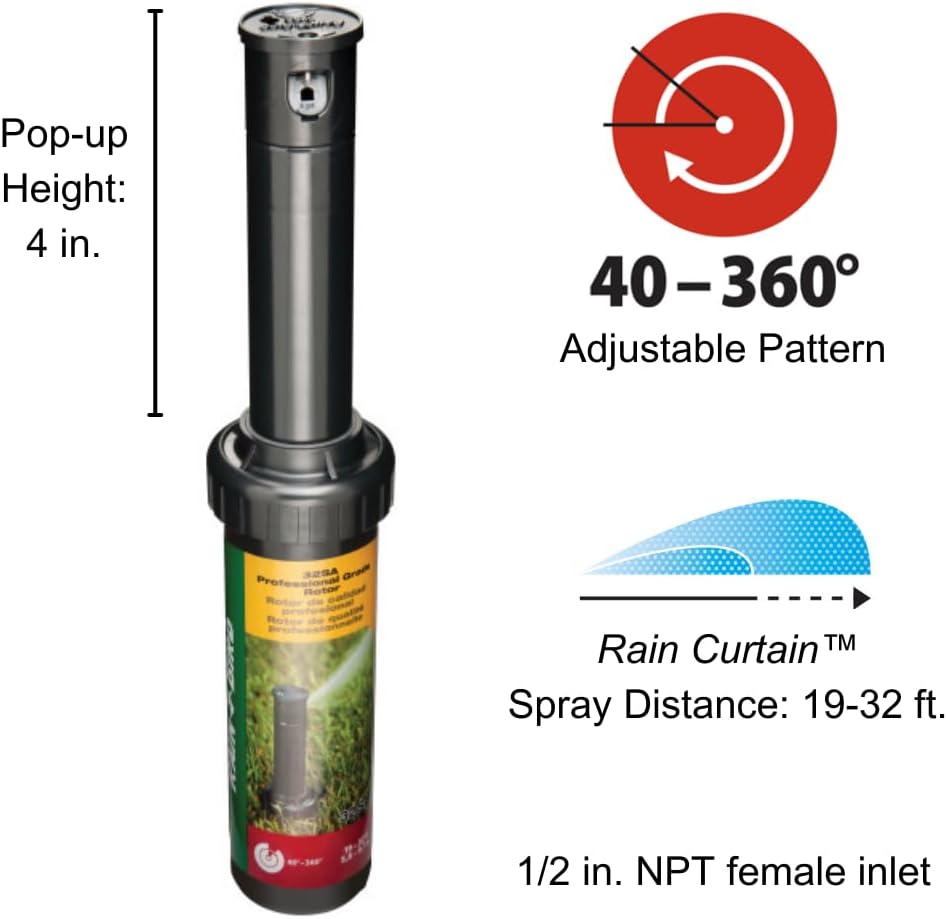
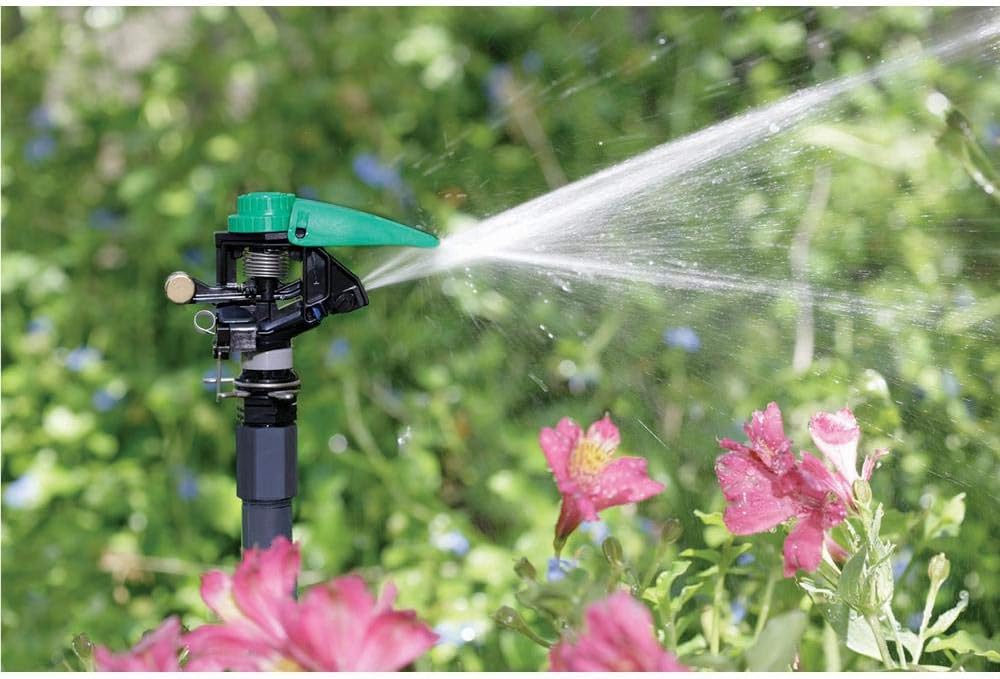
If you’ve ever stared at a box of sprinkler heads at the supply house and wondered why there are two completely different products that both claim to water your lawn — welcome to one of irrigation’s most genuinely useful debates. A rotor (like the Rain Bird 5000 or 5000 Plus series) is a pop-up sprinkler head that shoots a single rotating stream of water across a wide arc, covering large turf areas quickly. An MP Rotator (Hunter’s brand name, though the format is now called a “rotating nozzle” industry-wide) fits on a standard pop-up spray body and fires multiple slow-moving streams at a much lower flow rate, soaking the soil gently over a longer run time. Both water grass. They do it differently enough that choosing the wrong one for your zone will either waste water, stress your pump or meter, or leave dry spots you’ll blame on your controller. This article will show you exactly how to choose — and the answer almost always lives in one number: your available GPM (gallons per minute) budget.
The Core Tradeoff: High Flow Fast vs. Low Flow Slow
Here’s the honest one-sentence version of this entire debate: rotors move more water per head per minute; MP rotators move less water per head per minute but apply it more uniformly and at a precipitation rate your soil can actually absorb.
Precipitation rate is how fast water is being deposited on the ground, expressed in inches per hour (in/hr). Think of it like rain: a light drizzle (0.4 in/hr) soaks in; a summer cloudburst (2.0 in/hr) runs off the curb. Most residential lawns have an infiltration rate — the speed at which water moves into the soil — somewhere between 0.5 and 1.0 in/hr for loam, and as low as 0.2 in/hr for compacted clay. If your heads apply water faster than the ground can absorb it, you get runoff, puddling, and erosion on slopes even when the timer is set correctly.
GPM budget is the total flow your irrigation system can pull from the water source at once without dropping pressure so low that heads perform outside their rated specs. According to the UC ANR Landscape Irrigation Design Manual (University of California Agriculture and Natural Resources), a standard residential service with a 3/4-inch meter typically supports a usable irrigation flow of 10–15 GPM at the manifold — though measuring your specific site with a flow meter and pressure gauge at the hose bib is always the correct starting point. This budget is your hard ceiling, and it forces the rotor-vs-MP decision more than any other single factor.
Head-to-Head: Three Scenarios That Reveal the Right Choice
The comparison between rotors and MP rotators isn’t settled by brand preference. It’s settled by matching three variables — soil type, zone geometry, and GPM budget — to the right technology. The three H3 sections below walk through each primary decision scenario.
Scenario 1: Large Open Turf, Sandy Soil, Tight GPM Window
Rain
$8.37
In stock on Amazon
Check price on AmazonA rear lawn of 2,400 square feet (roughly 40 × 60 ft) with sandy loam soil and a usable manifold flow of 12 GPM is the classic rotor scenario. According to the Rain Bird Corporation 5000 Series Rotor Technical Specification Sheet, a single 5000-series head running at 45 PSI with a standard nozzle covers a throw radius of roughly 25–50 feet and flows approximately 0.7 to 3.5 GPM per head depending on nozzle choice and arc setting.
For this zone, six heads on a mid-range nozzle draws roughly 9 GPM total — comfortably under the 12 GPM budget — and applies water at approximately 0.7 in/hr. Sandy loam handles that rate without runoff. Runtime for one inch of water lands around 86 minutes.
The Irrigation Association’s Landscape Irrigation Scheduling and Water Management guidance identifies rotor precipitation rates on slopes as a common source of runoff waste on clay-heavy or compacted soils. For this scenario — flat, sandy loam, wide spacing — that concern doesn’t apply, and rotors are the pragmatic, cost-efficient choice.
Specify: Rain Bird 5000 Plus series with matched-precipitation nozzle sets. Matched-precipitation nozzles keep in/hr consistent across variable-arc heads in the same zone, which meaningfully improves distribution uniformity and is worth the small upcharge.
Rain
$8.37
In stock on Amazon
Check price on AmazonScenario 2: Clay or Compacted Soil, Slopes, Retrofit Opportunity
Rain
$11.36
In stock on Amazon
Check price on AmazonClay soil has an infiltration rate as low as 0.2 in/hr. A standard rotor applying water at 0.7–1.0 in/hr on clay will generate visible runoff within minutes, regardless of how well the zone is designed. This is the scenario MP rotators were purpose-built to solve.
According to the Hunter Industries MP Rotator Product Data and Application Guide, the MP Rotator product line — MP1000, MP2000, and MP3500 (where the number roughly indicates throw radius) — applies water at 0.4 in/hr or below across the product line. Flow per head runs approximately 0.2 to 0.8 GPM depending on model, dramatically lower than a rotor.
The EPA WaterSense program (epa.gov/watersense) specifically recognizes rotating nozzle technology as a water-efficiency upgrade, and Hunter’s MP Rotators carry WaterSense certification. That certification reflects real-world performance: the slow, multi-stream application pattern gives clay soil time to absorb each increment of water before the next stream arrives at the same spot.
For retrofit situations — where an older system was built around spray-body infrastructure at 12–15 ft spacing — swapping fixed nozzles for MP rotators can cut zone flow demand by 30–50%, often resolving pressure problems that owners previously blamed on the controller or valve. The Irrigation Association’s scheduling guidance acknowledges this retrofit benefit and notes that uniformity improvements are typically measurable after a simple nozzle swap without any pipe work.
Specify: Hunter MP Rotators (MP1000, MP2000, or MP3500 by radius need) on Hunter Pro-Spray or Rain Bird 1800-series spray bodies with pressure-regulating stems set to 40 PSI. The Hunter Industries MP Rotator Product Data and Application Guide shows distribution uniformity degrading meaningfully above 45 PSI, so if your static pressure runs above 70 PSI at the valve — common in newer subdivisions — pressure-regulating bodies are not optional, they are required.
Runtime trade-off: A zone needing 1 inch of water from MP heads at 0.4 in/hr needs 150 minutes of runtime. Pair this with cycle-and-soak scheduling (three 30-minute cycles with 45-minute soak intervals, for example) to keep water in the root zone on days when a single long run would exceed the soil’s infiltration capacity.
Rain
$11.36
In stock on Amazon
Check price on AmazonScenario 3: Smart Controller Integration, Mixed Soil, Efficiency-First Design
Rain
$37.08
In stock on Amazon
Check price on AmazonWhen the project includes a smart controller — Rachio 3, Hunter Pro-HC, or a similar WaterSense-labeled platform — the runtime penalty of MP rotators essentially disappears as a planning constraint. These controllers manage cycle-and-soak automatically using flex daily schedules or built-in smart cycle features. The EPA WaterSense label program (epa.gov/watersense) recognizes both smart controller platforms and rotating nozzle formats, creating a compounding efficiency argument for clients prioritizing water conservation or compliance with local restrictions.
In this scenario, MP rotators on smart-controller zones routinely outperform rotors on standard timer zones on a seasonal water-use basis, because the controller is continuously adjusting runtime based on evapotranspiration data rather than a fixed schedule set in April and forgotten until October. The UC ANR Landscape Irrigation Design Manual recommends calculating precipitation rate and matching it to soil infiltration rate before selecting head type, and smart controllers make this match dynamic rather than static — they effectively act as a real-time corrector for whatever precipitation rate your heads deliver.
For large light-commercial properties with 1.5-inch or 2-inch meters where GPM is not the limiting factor, rotors still win on installation efficiency: fewer heads, faster install, simpler zoning, shorter runtimes. But for residential systems where water budgets, tiered rates, and watering-day restrictions are the real-world constraints, the MP rotator paired with a smart controller is the premium specification.
Specify: Hunter MP Rotators or Rain Bird R-Van series rotating nozzles on pressure-regulating spray bodies, paired with a WaterSense-certified smart controller. Program initial runtime using the precipitation rate from the Hunter Industries MP Rotator Product Data and Application Guide for your specific model, then allow the controller’s ET-based algorithm to refine from there.
Rain
$37.08
In stock on Amazon
Check price on AmazonThe GPM Math: A Decision-Forcing Comparison Table
The table below uses a 2,400 sq ft rear lawn at 12 GPM usable manifold flow as the common reference scenario. Figures are based on Rain Bird Corporation 5000 Series Rotor Technical Specification Sheet and Hunter Industries MP Rotator Product Data and Application Guide.
| Head Type | Heads Needed | GPM/Head (typical) | Zone Total GPM | Precip Rate | Runtime for 1” |
|---|---|---|---|---|---|
| Rain Bird 5000 Plus rotor | 6 | ~1.5 GPM | ~9 GPM | ~0.7 in/hr | ~86 min |
| Hunter MP2000 rotator | 12 | ~0.4 GPM | ~4.8 GPM | ~0.4 in/hr | ~150 min |
| Rain Bird R-Van (low-precip rotor) | 8 | ~0.6 GPM | ~4.8 GPM | ~0.4 in/hr | ~150 min |
The rotor zone at 9 GPM fits comfortably under the 12 GPM budget and waters efficiently when soil and terrain allow. The MP rotator zone at 4.8 GPM draws well under budget — leaving headroom for a booster zone or simultaneous drip circuit — but requires longer runtimes. If soil is clay or slopes exceed 5%, the runtime trade-off is the right trade-off.
The If/Then Framework for Your Active Design
If your soil is clay or compacted, or your zone includes any slope over 5%: Default to MP rotators. Runoff prevention alone justifies the longer runtime. Use cycle-and-soak scheduling.
If your zone is 30+ feet wide in all dimensions, your soil drains reasonably well, and your GPM budget is under 12 GPM: Rain Bird rotors on matched-precipitation nozzle sets are the efficient choice. You’ll cover more area per head and per dollar of pipe and fittings.
If you’re retrofitting a spray-zone system with existing 12–15 ft spacing: MP rotators are almost certainly correct. You are not ripping out spray bodies; you are upgrading nozzles. The flow reduction frequently resolves pressure problems in older systems that owners have lived with for years.
If your controller has smart cycle-and-soak: The runtime penalty of MP heads disappears as a constraint. Specify MP rotators freely and let the controller manage scheduling.
If you’re specifying a light-commercial property with a 1.5-inch or 2-inch meter: Rotors win on installation speed and runtime efficiency. GPM is not the binding constraint, and shorter runtimes matter when commercial properties have narrower overnight watering windows.
The Irrigation Association’s Landscape Irrigation Scheduling and Water Management best practices document frames the core principle cleanly: no head selection is correct in isolation. Calculate precipitation rate, compare it to your soil’s infiltration rate, then select the head that bridges the gap without creating runoff. Do that calculation first, and this choice makes itself.