June 5, 2026 • Tomás Guerreiro • 10 min reading time • Specs verified June 18, 2026
Building Around the Rain Bird ESP-TM2: The Modular Controller Strategy for Serious Multi-Zone Systems
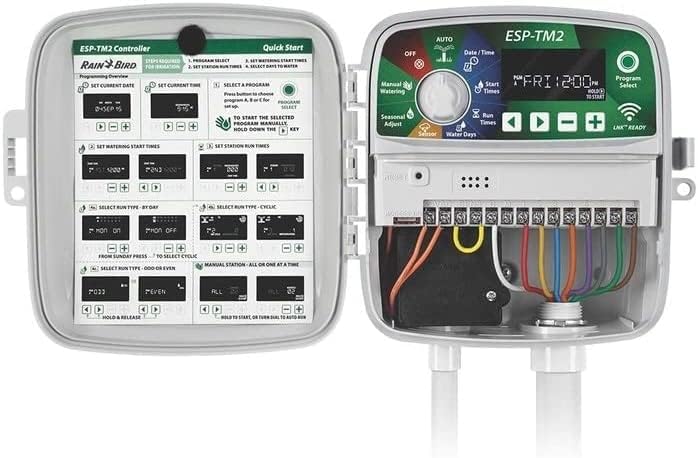
If you have ever tried to plan a sprinkler system for more than a couple of zones — a zone is simply a group of sprinkler heads or drip emitters controlled by a single valve that opens and closes on a schedule — you have probably run into the same wall: most consumer controllers top out at six or eight zones, and the moment your yard grows past that, you are buying a second box, wiring two systems, and managing two schedules. The Rain Bird ESP-TM2 is built to solve exactly that problem. It starts as a 6-zone controller and expands, using plug-in modules (think of them like expansion packs for your sprinkler brain), all the way up to 22 zones in a single enclosure. This article breaks down when that modularity is worth the investment, how to spec the zone count your property actually needs, and how to pair the ESP-TM2 with the right valves and nozzles to build a system that will still be earning its keep in fifteen years.
| EDITOR'S PICKRain-Bird Controller Indoor Out… | Mid-tier[Rain Bird LNK2 Smart WiFi Modul…](https://www.amazon.com/dp/B01MUVVSSF?tag=greenflower20-20) | Budget pick[Rain Bird ARC6 App-Based Indoor…](https://www.amazon.com/dp/B0CYN2D41N?tag=greenflower20-20) | |
|---|---|---|---|
| Zones / Stations | — | — | 6 |
| Modules Included | 3 | — | — |
| Compatibility | — | TRU, ESP-TM2, ESP-ME3, ESP-RZXe | — |
| Location | Indoor/Outdoor | — | Indoor |
| Price | $518.25 | $98.33 | $93.60 |
| See on Amazon → | See on Amazon → | See on Amazon → |
Why Modular Architecture Matters (and When It Does Not)
Most residential controllers are fixed-zone units. They ship with a set number of terminals — the physical connection points where each zone’s wiring lands — and that is the permanent limit. If you buy a 6-zone Orbit or an entry-level Rain Bird and later add a vegetable garden bed, a slope with its own watering needs, or a front-lawn expansion, you either max out the box or buy a second controller. That is not a disaster, but it creates scheduling headaches: two boxes, two apps (if they are smart-enabled), and two points of failure.
The ESP-TM2 sidesteps this with a modular station-module system. The base unit ships in 6-, 12-, or 22-station configurations, and if you start with the 6-station base, you can add Rain Bird’s ESP-TM2 Station Modules — each module adds 4 stations — up to the 22-station ceiling. Per Rain Bird’s ESP-TM2 Installation and Operation Manual, the controller supports up to four expansion modules alongside the base terminals, and all zones run under one scheduling interface.
When does this matter most?
- You have more than 8 zones today, or a reasonable expectation of adding zones within 3–5 years.
- You are managing multiple irrigation types — rotary heads on turf, drip on beds, micro-spray on slopes — that legitimately need independent schedules because they have different precipitation rates (the speed at which water accumulates, measured in inches per hour).
- You are a light-commercial or multi-property operator who wants one controller architecture to standardize across jobs, so your team is not relearning a new UI every site.
When to skip it:
If your property is legitimately 6 zones and will stay that way — say, a flat suburban lot under 7,000 square feet with uniform turf — the ESP-TM2’s modular headroom is overhead you are paying for but not using. In that case, a fixed 6- or 8-zone smart controller is a cleaner fit.
The GPM/PSI Conversation You Have to Have First
Before zone count, before controller selection, before any module math: you need your water budget. This is the 800-lb gorilla that determines everything downstream.
Here is the two-number measurement you need:
-
Static pressure (PSI): Measure at the hose bib closest to your meter with nothing running. Most residential supplies land between 45 and 80 PSI. The Irrigation Association’s Landscape Irrigation Best Practices documentation recommends designing zones to operate between 30 and 50 PSI at the head — so if your static is 75 PSI, you will want a pressure regulator inline.
-
Flow rate (GPM — gallons per minute): Time how long it takes to fill a 5-gallon bucket at the same hose bib. Divide 5 by the number of seconds, then multiply by 60. That gives you a GPM figure. Subtract 25% as a design buffer (never run a system at 100% of available flow), and the remainder is your usable GPM budget.
Once you have your usable GPM, you can spec how many heads fit per zone. Hunter’s published rotary nozzle data (the MP Rotator, widely cited in irrigation design references including UC ANR Publication 8406 on ET-based scheduling) puts a single nozzle at roughly 0.4–1.0 GPM depending on radius. Rain Bird’s 5000 Series rotor runs 1.0–3.5 GPM per head. A zone with 8 rotors averaging 2.0 GPM each needs 16 GPM — if your usable budget is only 12 GPM, that zone needs to be split.
This exercise is how zone count actually gets calculated. Zone logic is not about preference; it is about fitting within your hydraulic envelope.
By the numbers — sample 12-zone ESP-TM2 system:
| Zone | Type | Heads | Avg GPM/Head | Zone GPM |
|---|---|---|---|---|
| 1–3 | Front turf (rotors) | 6 each | 2.2 | 13.2 |
| 4–6 | Side/rear turf (rotors) | 5 each | 2.2 | 11.0 |
| 7–9 | Mixed beds (drip) | 12 emitters each | 0.5 | 6.0 |
| 10–11 | Slope (MP Rotator) | 8 each | 0.6 | 4.8 |
| 12 | Vegetable garden (drip) | 10 emitters | 0.5 | 5.0 |
Each zone runs independently; peak simultaneous demand is one zone at a time, keeping total draw well within a typical 15–18 GPM residential service.
Building the System: Valves, Manifolds, and Nozzle Selection
The ESP-TM2 is a controller — a brain. It sends a 24-volt AC signal to each valve (the electromechanical gate that opens and closes water flow to a zone) on schedule. Valve and nozzle selection are where system performance actually lives.
Valve pairing for the ESP-TM2:
Rain Bird’s own DV and DVF Series valves are the natural pairing — they are engineered to the same commercial-grade specs as the controller, and operators in long-run reviews consistently note that matching brands simplifies troubleshooting because pressure ratings and solenoid specs are already harmonized. The DVF (filter-and-flow-control version) is worth the modest upcharge for any drip or low-volume zone, because it integrates a filter and lets you dial in flow at the valve rather than fighting it zone by zone.
For higher-demand turf zones, the Rain Bird EFB-CP (electric filter ball valve, commercial-grade) is a step up. Spec sheets put its flow range at 0.1–30 GPM with a pressure rating to 150 PSI — headroom that matters if you are on a high-pressure municipal supply.
Hunter’s PGV valve is a well-regarded alternative that will work fine electrically with the ESP-TM2 (24V AC is universal across brands), and operators in multi-brand install reviews note the PGV’s internal pressure regulation as a standout feature for mixed-pressure sites. There is no loyalty penalty for mixing valve brands — the controller speaks the same electrical language to all of them.
Manifold strategy for drip zones:
Drip irrigation — emitters that deliver water slowly and directly to root zones — runs at much lower pressure than rotary heads, typically 15–25 PSI. If your incoming pressure is 65 PSI, an unregulated drip zone will blow emitters and cause wildly uneven distribution. A pressure-regulated drip manifold — Rain Bird’s XF Series or Hunter’s X-Core drip manifolds are common choices among spec installers — solves this at the manifold level rather than requiring individual pressure-compensating emitters at every plant. This matters at scale: on a 12-zone drip system, manifold-level regulation is far cheaper than compensating emitter by emitter.
Per the EPA WaterSense landscape guidelines, drip systems that are properly pressure-regulated can achieve distribution uniformity above 90%, compared to 70–75% for conventional spray heads — meaning water lands where plants need it rather than where wind or pressure variance pushes it.
Nozzle selection — the precipitation rate problem:
This is where many intermediate builders make the mistake that haunts them later: mixing head types within a zone. Rotary nozzles (like Rain Bird’s R-VAN or the Hunter MP Rotator) deliver roughly 0.4–0.6 inches per hour. Fixed-spray nozzles deliver 1.0–2.0 inches per hour. Putting both in the same zone means the fixed-spray heads waterlog their areas while the rotaries are still catching up — a phenomenon the Irrigation Association’s best practices documentation calls precipitation rate mismatch, and it is one of the leading causes of turf disease and runoff on otherwise well-designed systems.
Rule of thumb: Matched precipitation rate (MPR) nozzles within a zone, different head types get different zones. Full stop.
Smart Integration: What the ESP-TM2 Supports and What It Does Not
The ESP-TM2 is not a native Wi-Fi controller out of the box. It is a solid scheduling platform with support for Rain Bird’s LNK Wi-Fi Module (sold separately), which connects the controller to the Rain Bird app and enables ET-based (evapotranspiration-based — meaning the system adjusts watering based on real-time local weather and plant water-use calculations) scheduling via Rain Bird’s WeatherSense or Flow-Smart modules.
This is a meaningful distinction compared to the Rachio 3, which is Wi-Fi-native from power-on. The ESP-TM2’s modular approach means you are paying for smart features only if you need them — a legitimate advantage on a multi-property commercial operation where one property might need full smart scheduling and another might run on a fixed monthly program.
Per This Old House’s overview of smart irrigation controllers, ET-based scheduling can reduce outdoor water use by 20–50% compared to fixed-time programs — a range wide enough that actual savings depend heavily on your climate, soil type, and baseline schedule discipline. UC ANR Publication 8406 narrows this for California climates to a more consistent 30–40% reduction when ET scheduling is implemented correctly alongside matched-precipitation-rate nozzles.
What the ESP-TM2 does not do natively: Two-way flow sensing without the optional Rain Bird TBOS-II or external flow sensor, rain-skip without a separate sensor (though a simple rain sensor wired to the sensor terminal satisfies most jurisdictions’ requirements), and no native HomeKit or Alexa integration — the LNK module talks to the Rain Bird app only.
If deep smart-home integration is a priority, the Rachio 3 is the honest answer. If hydraulic capacity, zone count, and long-term expandability are the priority, the ESP-TM2 holds the lead.
The Buying Decision
Here is the decision frame, plainly:
If your system is 6–8 zones, fixed, and you want smart scheduling out of the box: The ESP-TM2 is overbuilt for you. Look at the Rachio 3 (8-zone) or Hunter Pro-HC.
If your system is 8–15 zones, growing, or mixed-type (turf plus drip plus slope): The ESP-TM2 12-station base with one or two expansion modules is the right call. Start with the 12-station unit, add modules as zones are added, and pair it with the LNK Wi-Fi module for scheduling flexibility. Source the controller and station modules from Sprinkler Supply Store or IrrigationDirect, where commercial-grade pricing applies and technical support staff are familiar with the product line.
If you are speccing a 16–22 zone commercial or estate system: The ESP-TM2 22-station is your baseline. Pair it with Rain Bird DVF valves on all drip zones, EFB-CP valves on high-flow turf zones, and a pressure-regulated manifold for any drip manifold running off a high-pressure municipal supply. Add the LNK module and a Rain Bird WR2 rain/freeze sensor to satisfy most state water management ordinances.
If you add zones later: Buy the expansion modules now and leave them uninstalled. The marginal cost of having them on the shelf is low; the cost of a service call to retrofit them later is not.
The ESP-TM2’s real value is not any single feature — it is the architecture. A system built around it today can absorb a pool-surround drip zone next spring, a vegetable garden expansion the following fall, and a driveway median project the year after that, all without replacing the controller. That is the math that justifies the price premium, and over a 10–15 year system lifespan, it is math that holds up.