May 13, 2026 • Tomás Guerreiro • 9 min reading time • Specs verified June 18, 2026
Hunter MP Rotator Nozzle Selection: Match Radius, Arc, and Precipitation Rate Before You Dig a Single Head
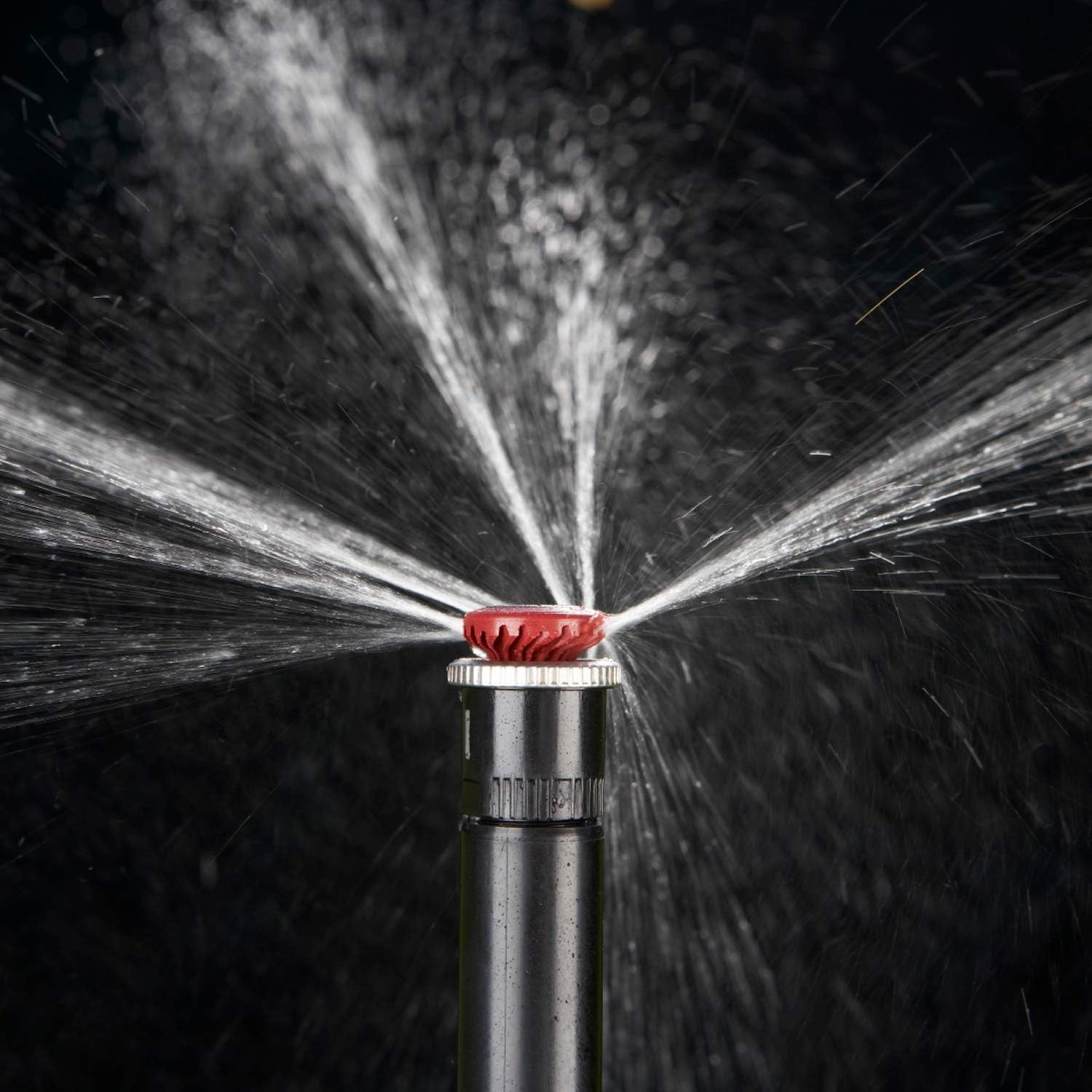
If you’ve been doing irrigation installs for even a season, you already know the standard-spray nozzle problem: too much water delivered too fast, runoff sheeting down the sidewalk before the soil can drink a drop. Hunter’s MP Rotator nozzles were engineered to solve exactly that. Instead of blasting water in a fixed fan, they spin multiple streams slowly across the turf — more like rainfall, less like a pressure washer. The result is a dramatically lower precipitation rate (how fast water is applied, measured in inches per hour), which gives clay soils and slopes time to absorb moisture rather than shedding it. But here’s the catch that trips up even experienced installers: the MP Rotator family has more than a dozen SKUs spanning three radius ranges, four arc patterns, and two specialty configurations. Grab the wrong one at the supply house and you’ll either have dry corners or — worse — mismatched precipitation rates across a zone, which no controller schedule can fully correct. This guide walks you through the selection logic so you’re making the call on paper, not in the field with a trench already open.
Why Precipitation Rate Matching Is the Non-Negotiable First Step
Here’s the mistake that costs people the most rework: mixing nozzle types with different precipitation rates (PR) in a single zone. A standard fixed-spray nozzle might deliver 1.5–2.0 inches per hour. MP Rotators are spec’d at roughly 0.4–1.0 inches per hour depending on the model — which is precisely why they reduce runoff. But if you run one fixed-spray body alongside MP Rotators on the same valve, the fixed-spray head will have already saturated the top two inches of soil by the time the MP Rotators have finished their job. You’ll either overwater the area near the fixed head or underwater the rotator coverage zone. There’s no schedule that splits that difference cleanly.
The Irrigation Association’s Landscape Irrigation Best Management Practices document is emphatic on this point: matched precipitation rate across all heads in a zone is a foundational design principle, not an optional refinement. EPA WaterSense program specifications reinforce it — a controller can only compensate for so much; the hardware has to be internally consistent first.
The practical rule before you pull a single part number: every head on a given valve should be the same nozzle family and, ideally, the same radius model. MP Rotators can share a zone with other MP Rotators. They should not share a zone with standard Hunter Pro-Spray or fixed-fan equivalents.
Decoding the MP Rotator Model Number
Hunter’s part numbering system is actually readable once you know the key. A typical SKU looks like this: MP2000-90. Breaking it down:
- MP — the product family (Multi-Stream, Multi-Trajectory rotating nozzle)
- 2000 — the radius in feet (in this case, a 20-foot radius at reference pressure)
- 90 — the arc in degrees (90° = quarter circle)
The main radius models in the 2025 Hunter product lineup are:
| Model | Radius Range | Typical PR (in/hr) | Common Arc Options |
|---|---|---|---|
| MP1000 | 8–15 ft | ~0.4 in/hr | 90°, 180°, 210°–270°, 360° |
| MP2000 | 13–21 ft | ~0.4 in/hr | 90°, 180°, 210°–270°, 360° |
| MP3000 | 20–30 ft | ~0.4 in/hr | 90°, 180°, 210°–270°, 360° |
| MP Corner | 4–8 ft (corner fill) | ~0.6 in/hr | Fixed corner geometry |
| MP Side Strip | 5 ft × 18 ft (strip) | varies | Narrow rectangular pattern |
By the numbers:
- Operating pressure sweet spot: 40–55 PSI (Hunter spec sheet)
- Flow per head at 45 PSI: approximately 0.2–0.7 GPM depending on radius and arc
- Precipitation rate across the radius family: within ±10% — this is why you can mix MP1000 and MP2000 in the same zone if geometry demands it, but check the spec sheet math first
The near-matched precipitation rate across the MP1000, MP2000, and MP3000 radius models is the feature that makes this family flexible. University of California ANR’s landscape irrigation scheduling resources note that matched PR across zones directly enables accurate ET-based scheduling, which is what your Rachio 3 or Hunter Pro-HC is trying to calculate. Give the controller inconsistent hardware and its soil moisture modeling becomes guesswork.
Radius and Arc Selection: The Zone Geometry Workflow
This is where practitioners who are still building intuition tend to shortcut — and pay for it in callback visits. The correct sequence is:
1. Measure your space precisely, then subtract 10–15%. Hunter’s published radius specs assume reference operating pressure (typically 45 PSI at the head). In real-world installs, you’re often running 5–10 PSI lower at the last head on a long lateral, which shrinks effective radius. Colorado State University Extension’s turfgrass water requirements guide flags lateral pressure loss as one of the most common reasons for dry spots near zone perimeters. Design to 85–90% of the published maximum radius. For a 30-foot span, that means an MP3000 at center is your play, not an MP2000 stretched.
2. Apply head-to-head coverage, not head-to-perimeter. The industry standard is head-to-head spacing: each head’s radius should reach the adjacent head. On a 20-foot-wide turf strip, you’d space MP2000 heads 18–20 feet apart. On a 30-foot-wide area, MP3000s at 25-foot centers. Head-to-head coverage compensates for wind drift and the natural thinning of stream density at the outer radius.
3. Assign arc before SKU. Walk every head position and ask: how many degrees of unobstructed throw does this location have? Corner positions get 90°. Edge positions along a straight run get 180°. Interior positions surrounded by turf get 360°. Hunter’s corner and side-strip specialty models handle the geometric edge cases that rotators handle poorly — use them rather than trying to force a 90° MP2000 to cover a geometry it wasn’t designed for.
4. Check your GPM budget against the arc-adjusted flow. A 360° MP2000 flows roughly 3–4× what a 90° MP2000 flows, because it’s covering 4× the area in the same runtime. This matters when you’re calculating zone flow load against your available GPM at the meter. The Irrigation Association’s best practices document recommends keeping zone flow at 75% or less of the main line’s capacity to maintain stable pressure. Run the math on every zone before finalizing head count.
A Practical Zone Design Example
Say you’re designing a 40 × 30-foot rectangular lawn panel. Available pressure at the backflow preventer: 65 PSI static, 52 PSI dynamic (measured with a flow gauge at the hose bib — if you haven’t measured yours yet, that has to happen before any of this matters). Lateral pressure loss budgeted at 8 PSI across a 60-foot run leaves approximately 44 PSI at the farthest head — comfortably inside the MP Rotator’s 40–55 PSI operating window.
Head layout for this panel:
- 4 corner positions: MP2000-90 (quarter-circle)
- 4 edge-center positions: MP2000-180 (half-circle)
- 1 center position if the panel was larger: MP2000-360 — but at 40 × 30 ft, head-to-head from the edges covers center without an interior head
Zone flow estimate: 4 × (0.28 GPM for MP2000-90) + 4 × (0.56 GPM for MP2000-180) = 1.12 + 2.24 = 3.36 GPM total zone load. If your meter service delivers 10–12 GPM at working pressure, this zone uses roughly 28–34% of available flow — leaving headroom to run a second zone simultaneously if your controller supports it and your pipe sizing supports parallel flow.
Pressure Regulation: The Hidden Variable That Changes Everything
One detail that separates competent MP Rotator installs from great ones: the nozzle itself can tolerate pressure variation, but it performs best on a stable inlet. If your system runs higher than 55 PSI at the heads, stream trajectory shifts, radius increases unpredictably, and precipitation rate uniformity degrades. Hunter publishes pressure-regulated bodies (the Hunter Pro-Spray with integrated pressure regulator) specifically to fix this. At 65 PSI or higher static pressure — which is common in newer municipal systems — pairing MP Rotators with regulated bodies isn’t optional, it’s the right call.
EPA WaterSense specifications for irrigation components call out pressure regulation as a core efficiency feature precisely because unregulated overpressure is one of the most common causes of misting, drift, and coverage inconsistency. If you’re spec-ing a system at the $1,500–$3,000 project level, regulated bodies add roughly $2–4 per head position — a trivial line item against a callback visit.
The Specialty SKUs: When to Reach for Corner and Strip Models
The MP Corner and MP Side Strip models confuse a lot of people because they don’t fit the standard radius-arc naming pattern. Here’s the decision logic:
Use MP Corner when you have a concave corner — say, where a fence meets a building — and the standard 90° arc from a standard rotator would throw water into the structure. The Corner nozzle’s geometry fills the near-field dead zone that a full-radius 90° pattern leaves.
Use MP Side Strip for narrow rectangular areas: a 4–5 foot median strip between a driveway and a sidewalk, a planting bed along a fence line. The strip pattern throws a rectangular distribution rather than a radial arc. Hunter’s published spec puts the strip at approximately 5 feet wide by 18 feet long at reference pressure. If your strip is narrower than 4 feet, drip is probably a better answer than any rotator.
Neither specialty model should be mixed with the radius-family MPs on the same zone without checking the PR differential — the strip and corner models run at a slightly higher application rate than the main radius family.
Buying Decision: If X, Then Y
Here’s the decision tree for the most common scenarios:
If your turf areas are under 15 feet in any dimension: MP1000 family. Don’t stretch an MP2000 into small spaces — the outer stream radius will overshoot onto hardscape.
If your zones are 15–25 feet wide: MP2000 is the workhorse. This is the most common SKU in residential installs and where Hunter has concentrated the most performance testing in their published data.
If you’re covering large turf panels — athletic fields, commercial lawns, or large residential backyards over 25 feet wide: MP3000. Confirm you have 40+ PSI at the head before committing.
If your static pressure runs above 60 PSI: Order regulated spray bodies alongside every MP Rotator. Hunter Pro-Spray bodies with integrated pressure regulators are the direct pairing the manufacturer specifies.
If you have tight strips or concave corners: reach for the specialty SKUs first rather than trying to adjust arc on a standard model.
Where to source: Sprinkler Supply Store and IrrigationDirect both stock the full MP Rotator family including specialty models, typically at contractor pricing below big-box retail. For a single-zone retrofit, buying a trial pack of three or four nozzles before committing to a full zone order lets you confirm coverage geometry on the surface before trenching — a low-cost insurance step worth the extra shipping cycle.
The MP Rotator family rewards the installer who does the geometry and pressure math up front. The nozzle selection itself is straightforward once you have those numbers in hand. Measure pressure, map your head positions, assign arcs, check zone GPM, specify regulated bodies if pressure is high — in that order. Do it on paper first. The trench can wait.