May 23, 2026 • Tomás Guerreiro • 9 min reading time • Specs verified June 18, 2026
No-Dig Smart Irrigation: Hose-Bib Timers and WiFi Water Timers That Add Zone Intelligence Without Trenching
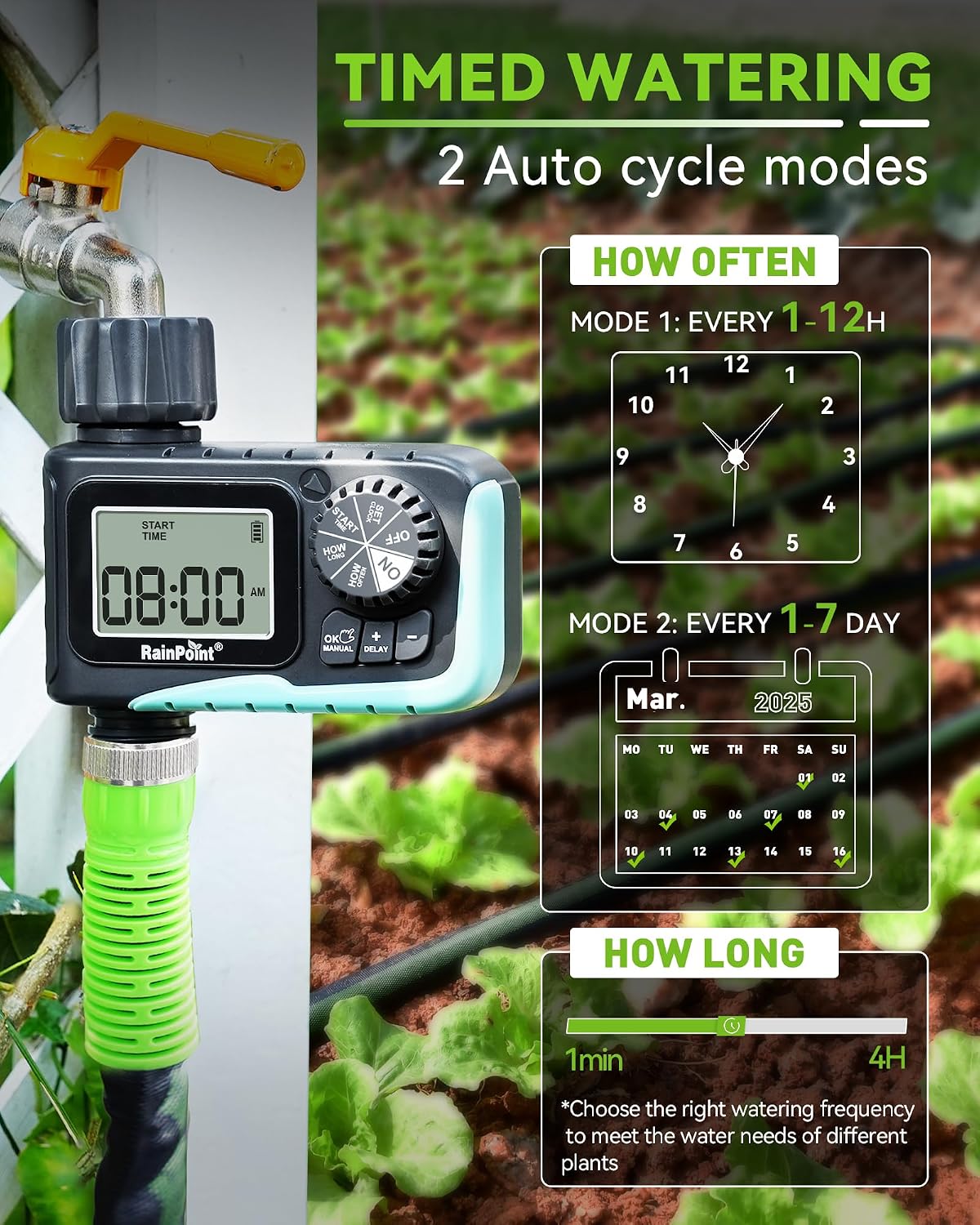
You’ve got a spigot on the side of your house, a drip line snaking through your raised beds, and a soaker hose looping your front foundation plantings. Getting that setup to water itself — smartly, on a schedule that adjusts for rain — is exactly what a hose-bib timer (also called a faucet timer or spigot timer) is designed to do. These are battery-powered or WiFi-connected devices that thread onto your outdoor faucet and control when water flows, just like a programmable thermostat controls your furnace. No trenching. No permit. No controller wired to a valve box. If you’ve been managing irrigation manually or with a cheap dial-type timer, this article will show you where the real gains are — and when you’ve outgrown this approach entirely.
| EDITOR'S PICK[Orbit B-hyve XD 4-Port Smart Ho…](https://www.amazon.com/dp/B0B1QWVQPY?tag=greenflower20-20) | Mid-tierOrbit B-hyve XD 4-Port Smart Ho… | Budget pickBiswing 4 Way Brass Hose Splitt… | |
|---|---|---|---|
| WiFi | ✓ | ✗ | — |
| Bluetooth | — | ✓ | — |
| Material | — | — | Brass |
| Hub Included | ✓ | ✗ | — |
| Price | $129.98 | $77.20 | $18.99 |
| See on Amazon → | See on Amazon → | See on Amazon → |
Why “No-Dig” Irrigation Gets Serious Faster Than Most People Expect
The honest framing: hose-bib timers started as a convenience product for apartment balcony gardens and vacation homes. But the category has matured considerably. As of 2026, the best WiFi-enabled faucet timers now connect to weather APIs, support multi-zone scheduling through manifold splitters, log flow data, and integrate with broader smart-home ecosystems. Per the EPA WaterSense program’s outdoor water use fact sheet, landscape irrigation accounts for nearly one-third of all residential water use nationally — and up to 50 percent in drier western climates. A smart timer that prevents a single unnecessary 20-minute run daily can save thousands of gallons per season. That’s not a toy product anymore.
The Irrigation Association’s landscape best management practices document makes a distinction worth internalizing: scheduled irrigation (run at a fixed time) versus ET-adjusted irrigation (run based on evapotranspiration, or how much water your plants actually lost to heat and wind that day). Most cheap dial timers do the former. The better WiFi timers now attempt the latter. That’s the gap this article is navigating.
What you’ll get here: a clear-eyed breakdown of the timer categories, the math that determines whether you’re in-scope for this approach or should trench instead, and a direct buying-decision framework for practitioners who have a real yard problem to solve right now.
The Three Tiers of Hose-Bib Timer — and What Each One Actually Does
Tier 1: Mechanical and Basic Digital (Under $30)
These are single-outlet, battery-powered timers with a fixed on/off schedule. Think of the Orbit 56082 or Melnor 65041-AMZ. They do exactly one thing: open the valve at time A, close it at time B.
What they get right: Simplicity, reliability, zero connectivity to lose. This Old House’s installation guide for hose-end timers notes that mechanical units are often the right call for a single drip zone with consistent water needs — a vegetable garden on a flat site with the same daily water requirement all season.
Where they fail: No rain sensor input, no ET adjustment, no way to manage more than one valve without buying a separate unit per faucet. If you’re watering three different microhabitats (sun-exposed turf edge, shaded beds, a pot cluster on a deck), you can stack three of these — but you’re programming each one manually, in isolation, with no coordination.
Tier 2: Multi-Zone Faucet Controllers with Manual Scheduling ($60–$150)
The step-up category pairs a manifold (a splitter block with two to four independent solenoid valves, each controllable separately) with a single battery-powered controller head. The Orbit B-hyve 4-Outlet Timer and the Melnor 4-Zone Digital Water Timer are the category anchors. You program each zone independently — zone 1 runs drip to beds at 6 a.m. for 20 minutes, zone 2 runs soaker hose to shrubs at 6:30 a.m. for 15 minutes.
The real upgrade here is zone logic without infrastructure. UCANR’s guide to estimating irrigation water needs for landscape plantings is explicit that different plant types have meaningfully different water requirements — turfgrass, for example, typically needs roughly twice the weekly water of established woody shrubs under similar conditions. Running them on separate schedules, even from a single faucet, is the right horticultural call.
Limitation: These units still run on user-set schedules. They don’t know it rained yesterday.
Tier 3: WiFi-Connected Smart Faucet Timers ($80–$250)
This is where the category gets interesting for practitioners. The Orbit B-hyve Smart Hose Faucet Timer (with WiFi hub), the Rachio Hose Timer, and the LinkTap G2S are the products most frequently cited in aggregated long-run reviews as delivering on the smart-irrigation promise without an in-ground system.
Key capabilities at this tier:
- Weather intelligence: Pulls local forecast or historical ET data and skips or shortens scheduled runs when rainfall makes them unnecessary
- App-based programming: Schedule edits happen from anywhere; you’re not crouching at the spigot with wet hands
- Flow monitoring (select models): The LinkTap line, per its published spec sheet, includes a flow meter that can alert you to leaks or abnormally high flow — a feature that previously required a commercial flow sensor wired into an in-ground system
- Smart-home integration: Most connect to Amazon Alexa, Google Home, or Apple HomeKit
Owners consistently report that the weather-skip feature alone — preventing unnecessary run cycles during or after rain events — justifies the price premium over Tier 2 units within a single irrigation season for yards above ~2,000 square feet of plantings.
The GPM/PSI Reality Check You Can’t Skip
Before speccing any hose-bib irrigation setup, you need two numbers: your flow rate (GPM — gallons per minute) and your static pressure (PSI — pounds per square inch). These aren’t optional. They’re the ceiling your entire system must fit under.
How to measure:
- Flow: time how long it takes to fill a 5-gallon bucket at the hose bib. 60 seconds = 5 GPM. 90 seconds ≈ 3.3 GPM.
- Pressure: attach a $15 pressure gauge (available at any hardware store) to the faucet and read it with nothing else running.
By the numbers — typical hose-bib irrigation math:
| Setup | GPM draw | Viable at 40 PSI / 4 GPM faucet? |
|---|---|---|
| Single drip zone (10 emitters × 1 GPH) | 0.17 GPM | Yes, easily |
| 4-zone manifold, 1 zone active at a time | 0.5–2.0 GPM | Yes, if zones aren’t concurrent |
| 2 zones running simultaneously | 1.5–4.0 GPM | Maybe — depends on emitter count |
| Rotary nozzle zone (4 heads) | 4–8 GPM | No — exceeds typical hose-bib supply |
This is the clearest signal you’ll get about when hose-bib timers stop being the right answer: the moment your zone demand approaches your faucet’s supply rate, you need a pressure-regulated in-ground system with a dedicated backflow preventer and valve manifold. Per the Irrigation Association’s best management practices, drip and micro-irrigation systems are specifically well-suited to low-flow, low-pressure delivery — which is exactly why they pair so naturally with hose-bib supply.
When to Upgrade Out of This Category (Honest Signals)
Smart hose-bib timers solve a real problem for a real audience. They’re the right tool for:
- Rental properties where you can’t trench
- HOA-governed lots with deed restrictions on in-ground modifications
- Seasonal gardens (raised beds, annual borders) that change layout year to year
- Budget-constrained first builds where the goal is learning zone logic before committing to a permanent system
- Properties already served by an in-ground system for turf, where supplemental drip for beds and containers is genuinely a “second layer” need
But reviewers and operators in longer-run use consistently flag three scenarios where the no-dig path runs out of road:
- More than 4–6 independently scheduled zones. Manifolds cap out, and running multiple manifolds from multiple faucets becomes harder to coordinate than a proper multi-zone controller.
- Zones that need to run concurrently. Hose-bib setups are typically sequential by necessity. A property with turf zones that need simultaneous lateral coverage requires a properly hydraulic-designed in-ground system.
- Larger properties with pressure drop over hose length. Every 100 feet of standard ¾-inch garden hose loses roughly 1–2 PSI to friction. At 200+ feet of run, you’re delivering materially less pressure to your emitters than you think.
If you’re hitting any of these, the next article in this series covers entry-level in-ground multi-zone systems starting at the $400–$800 component level.
Buying Decision: If X, Then Y
Here’s the framework, stated plainly:
If you have 1–2 zones of drip or soaker irrigation and want basic scheduling → Tier 1 mechanical timer (~$20–$25). Orbit and Melnor are the durable standards. Don’t overspend here.
If you have 2–4 zones with different plant types that need independent schedules → Tier 2 multi-zone battery timer ($60–$120). The Orbit B-hyve 4-outlet or Melnor 4-zone units handle this cleanly. You’ll program them manually, but zone separation alone is the win.
If you want weather-responsive scheduling, app control, and potential flow monitoring → Tier 3 WiFi timer. For pure smart-home integration, the Rachio Hose Timer integrates naturally with Rachio’s broader ecosystem and appeals to users who already run a Rachio 3 controller for in-ground zones. For standalone performance with flow monitoring, the LinkTap G2S gets consistent attention in aggregated reviews for its flow-alert feature and long battery life. For value at the WiFi tier, the Orbit B-hyve Smart Hose Faucet Timer (sold with the WiFi hub as a kit) is the entry point most practitioners start with.
If your zone count exceeds 4, or you need zones to run simultaneously, or your longest hose run exceeds 150 feet → This category can’t serve you well. Budget for a component-built in-ground system with a Rachio 3 or Rain Bird ESP-TM2 controller, pressure-regulated zone valves, and proper hydraulic design. The no-dig path got you started; the trench is the next step.
A Word on Flow Monitoring as a Standalone Win
One underappreciated use case for WiFi faucet timers in the practitioner segment: leak detection on irrigation circuits that don’t yet have inline flow sensors. A drip emitter that pops off its stake and runs open is invisible until your water bill arrives. The LinkTap G2S and a few competing units publish flow-alert thresholds in their spec documentation — set the expected flow window for a zone, and the controller alerts you if actual flow deviates. That’s not a toy feature. On a commercial property with 400 feet of drip tubing across a mixed perennial border, an undetected open emitter can waste 30–50 gallons per run. Over a season, that’s a real number. Per UCANR’s irrigation water needs guide, water losses from distribution inefficiency — not plant demand — are the primary source of overuse in residential and light-commercial landscapes.
A smart faucet timer with flow monitoring, on an isolated supplemental drip circuit, is a legitimate professional-grade tool at a sub-$200 price point. That’s the strongest argument for the category upgrade, and it’s the one most often undersold in product listings.
Where to Source
At the Tier 3 level, the Orbit B-hyve ecosystem is stocked at most big-box retailers. The Rachio Hose Timer and LinkTap units are more consistently available through specialty irrigation suppliers — Sprinkler Supply Store and IrrigationDirect both carry them, and their staff can advise on manifold compatibility. For manifold hardware (brass multi-outlet splitters, pressure regulators, filter assemblies), specialty irrigation distributors typically carry better-quality options than general hardware retail, and the per-unit cost difference is minimal at this scale.
Start at the spigot. Measure your GPM and PSI first. Then buy the tier of timer your zone count actually needs — not the one that looked best in the product listing.