June 16, 2026 • Tomás Guerreiro • 10 min reading time • Specs verified June 18, 2026
Measure Your GPM and PSI Before You Buy Anything: The Flow-Rate Audit Every DIY Irrigation Plan Starts With
You bought a Rachio 3. It’s sitting in its box. You’ve got a zone map sketched on a legal pad, a parts list on your phone, and genuine enthusiasm. Here’s the one thing that will save you from a very expensive redo: don’t install a single component until you know two numbers about your water supply. The first is GPM — gallons per minute — which tells you how much water your house pipe can actually deliver. The second is PSI — pounds per square inch — which tells you how hard that water is being pushed. Together, GPM and PSI are your irrigation budget. Spend beyond them and your rotary nozzles will sputter, your drip zones will starve, and your smart controller will make smart decisions based on dumb inputs. Spend within them and everything downstream — head selection, zone count, pipe sizing — falls into place with real logic behind it.
This article walks you through a two-tool, thirty-minute audit you do before you buy anything else. If you’ve already got some hardware in hand, the audit will tell you whether your zone plan is realistic or whether you need to restructure it. Either way, you need these numbers first.
Why GPM and PSI Are the 800-Pound Gorillas of Irrigation Design
Most DIY irrigation mistakes aren’t product mistakes — they’re budget mistakes. Someone buys eight Hunter PGP rotary heads rated at 2.0 GPM each, runs them in a single zone, and wonders why two heads on the far end barely rotate. The answer is math: 8 heads × 2.0 GPM = 16.0 GPM, and the supply line from the meter to the backflow preventer can only push 12 GPM before pressure collapses. The zone was overpopulated before the first head was driven.
The Irrigation Association’s Landscape Irrigation Auditor Certification Study Guide treats the available flow rate — what the IA calls “usable system capacity” — as the foundational constraint from which every other design parameter derives. Not head selection. Not controller choice. Flow first, everything else second.
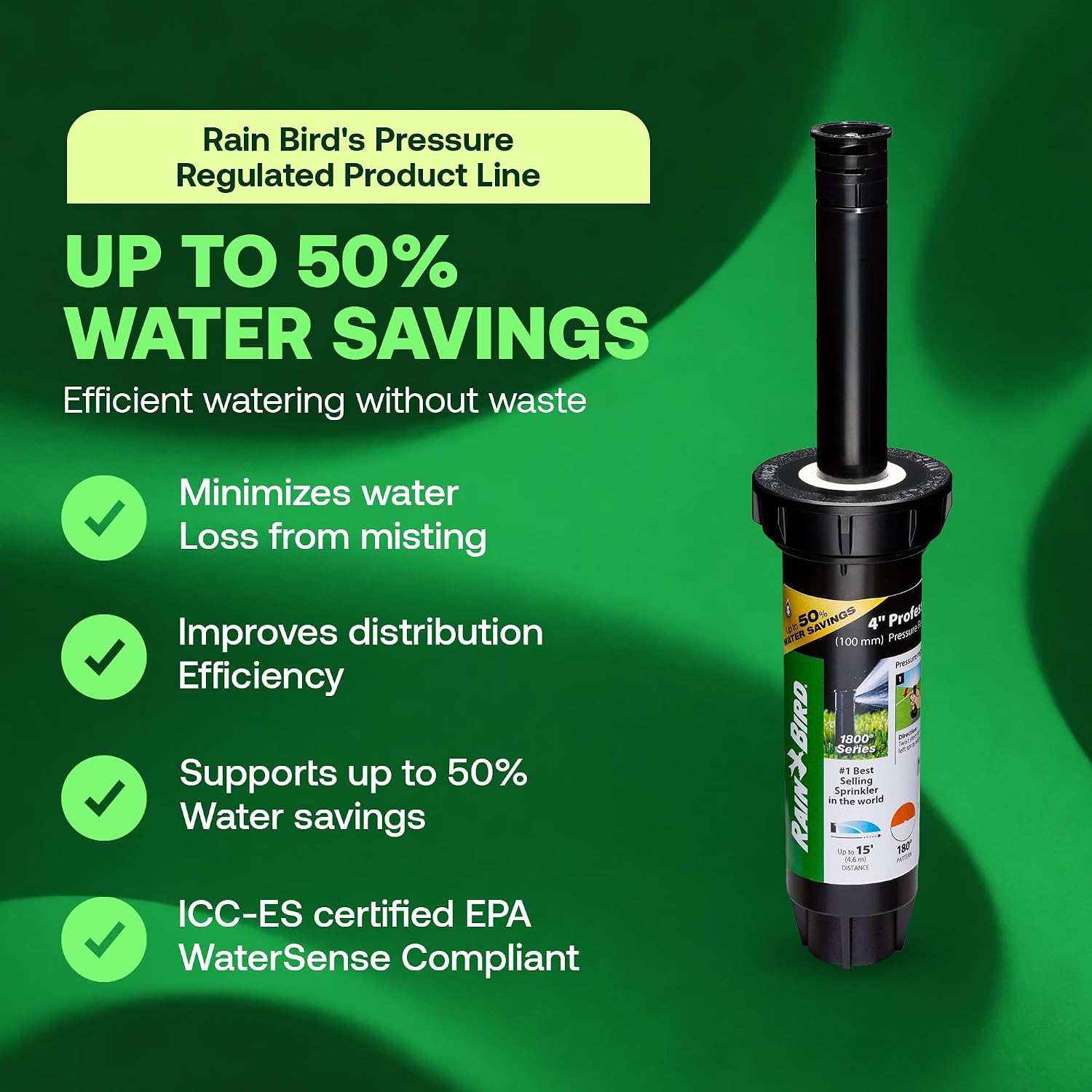
PSI compounds the problem. Pressure and flow are linked: run more zones simultaneously, pressure drops. Run undersized pipe, pressure drops. Run long lateral lines, pressure drops. The EPA WaterSense program’s guidance on water-efficient landscaping notes that operating heads outside their pressure design range — typically 30–45 PSI for most rotor heads — produces either misting (overpressure) or incomplete coverage arcs (underpressure), both of which drive up water waste while actually reducing coverage quality. Getting PSI wrong costs you money twice: in the water bill and in the re-spec.
The practical upshot: your GPM and PSI readings define the ceiling. Every zone decision, pipe diameter choice, and head model is a negotiation within that ceiling. Measure first; negotiate from a position of knowledge.
The Two-Tool Audit: What You Need and How to Do It
You need two inexpensive tools: a flow-rate bucket test kit (or a calibrated five-gallon bucket and a stopwatch) and a hose-bib pressure gauge. The pressure gauge runs $8–$15 at any hardware supply house and threads directly onto an outdoor hose bib. The Irrigation Association’s study guide and CSU Extension’s irrigation management publications both recommend this exact approach for residential audits — no specialized equipment required.
Step 1: Measure Static PSI
Static pressure is the pressure in your line when nothing is running. Screw the gauge onto the hose bib closest to your water meter (this gives you the least-traveled reading). Don’t open any other faucets. Read the gauge. Write the number down.
Typical residential static range: 50–80 PSI. If you’re reading below 40 PSI, you have a supply constraint that will limit which heads you can run and how many per zone. If you’re reading above 80 PSI, you likely need a pressure regulator on your irrigation mainline — unregulated high pressure causes head misting and accelerates valve wear. This Old House’s guidance on testing water pressure flags anything above 80 PSI as a condition requiring a pressure-reducing valve (PRV) before irrigation components are added.
Step 2: Measure Dynamic (Working) PSI
Now turn on a second hose bib or two indoor faucets simultaneously and re-read the gauge. This is your dynamic pressure — the pressure under realistic simultaneous-draw conditions. The difference between static and dynamic (called pressure loss under load) tells you how sensitive your supply line is to demand. A drop of more than 15 PSI between static and dynamic is a warning sign: your service line is undersized, your meter is marginal, or both.
Design your system around dynamic PSI, not static. Many first-time builders make the mistake of speccing to static pressure and then wonder why things underperform when a toilet flushes upstairs.
Step 3: Measure GPM
The cleanest field method: time how long it takes to fill a five-gallon bucket from the same hose bib, with the bib fully open.
GPM formula:
GPM = 60 ÷ seconds to fill 5 gallons × 5
If it took 50 seconds: 60 ÷ 50 × 5 = 6.0 GPM. If it took 30 seconds: 60 ÷ 30 × 5 = 10.0 GPM.
UC ANR’s Landscape Irrigation Design Manual recommends running this test three times and averaging the results to smooth out any pressure fluctuations from the municipal supply side. Takes four minutes. Worth doing.
By the Numbers: Interpreting Your Results
| Reading | What It Means | Design Implication |
|---|---|---|
| Static PSI < 40 | Marginal supply pressure | Limit heads per zone; use pressure-compensating drip |
| Static PSI 40–80 | Normal operating range | Standard head selection applies |
| Static PSI > 80 | High pressure | Add PRV to irrigation mainline |
| GPM < 6 | Low flow supply | Maximum ~2–3 heads per zone at 1.5–2.0 GPM each |
| GPM 6–12 | Typical residential | Standard zone sizing; 4–6 rotary heads per zone workable |
| GPM > 12 | Strong supply | Multi-head zones viable; confirm pipe sizing accordingly |
Translating the Numbers Into Zone Budget
Once you have GPM and PSI, the next step is calculating your usable zone budget — how many GPM you can safely allocate to a running zone without starving pressure at the heads.
The industry-standard rule, referenced in both the IA study guide and UC ANR’s design manual: design zones to consume no more than 75% of your measured dynamic GPM. This buffer accounts for pressure loss in the mainline, the backflow preventer, the valve, and the lateral piping between the valve and the furthest head.
If your dynamic GPM measures 10.0: 10.0 × 0.75 = 7.5 GPM per zone maximum.
Now map that against your head models. Hunter PGP rotary heads (a widely specified workhorse in this class) are rated at approximately 1.5–2.5 GPM depending on nozzle size and arc setting, per Hunter Industries’ published spec sheets. At 2.0 GPM average, a 7.5 GPM zone budget gives you three to four heads maximum per zone — not the six you might assume from looking at coverage radius alone.
Rain Bird’s 5000 Series rotors run a similar range: per Rain Bird published specifications, 1.5–4.0 GPM depending on nozzle and arc. At the higher nozzle sizes in large-arc applications, two or three heads can fill a zone budget fast.
Drip zones change the calculus. A pressure-compensating drip manifold running eight emitters at 0.5 GPH each draws roughly 0.07 GPM total — essentially invisible to your flow budget. This is why experienced designers separate drip and rotor zones not just for precipitation rate matching (though that matters too) but to keep individual zone GPM draws legible and predictable.
The tradeoff you’re actually managing: More zones equals more valves, more wire, more controller stations, and higher installation cost — but it also equals tighter GPM control per zone and better pressure performance at each head. Fewer zones saves hardware cost upfront and often creates pressure and coverage problems that are expensive to fix later. If you’re on the fence between four zones and six zones given your water budget, spec six. The incremental valve and wire cost is small compared to the cost of pulling pipe to add zones post-install.
Where PSI Loss Happens Between the Meter and the Head
Knowing your supply PSI is only part of the story. Pressure doesn’t teleport from the meter to the head — it loses a portion of itself at every transition. Understanding where loss occurs lets you predict working head pressure before you install anything.
The typical residential irrigation mainline encounters pressure loss at:
- The backflow preventer — a double-check valve assembly typically loses 5–10 PSI. A reduced-pressure zone (RPZ) backflow device loses more, often 10–15 PSI. The CSU Extension irrigation management publication specifically calls out backflow preventer pressure loss as the most commonly overlooked variable in residential system design.
- The zone control valve — 2–5 PSI depending on valve size and flow rate. Valves running above their rated flow lose disproportionately more.
- Mainline and lateral pipe friction — depends on pipe diameter and run length. At 7 GPM through ¾-inch PVC over 100 feet, friction loss is approximately 4–5 PSI per the Hazen-Williams friction loss tables referenced in the IA study guide. Undersizing pipe from ¾-inch to ½-inch on a 7 GPM lateral roughly triples friction loss — a critical mistake on long runs.
- Elevation change — every 2.31 feet of rise equals 1 PSI of loss. A head at the top of a slope loses measurable pressure compared to one at the base.
Add these up. If your dynamic PSI is 58, your backflow preventer drops 8, your valve drops 3, your lateral loses 5, and your slope adds 3 — you’re operating heads at 39 PSI. Most rotor heads want 30–45 PSI, so 39 is workable, but you have almost no margin. Spec a higher-nozzle rotor that wants 45 PSI and you’re in trouble before the first cycle runs.
The Buying Decision: If X, Then Y
Before you add anything to your cart:
If your dynamic GPM is below 6.0: Design exclusively for low-flow heads and drip. Consider Hunter MP Rotator nozzles (spec sheets rate them at 0.4–1.0 GPM per head), which were engineered specifically for low-flow supply conditions. Do not spec standard rotors until you resolve supply constraints.
If your static PSI exceeds 80: Add a pressure regulator to the irrigation mainline before any valve. Look at devices in the 1-inch line size if you’re running multiple simultaneous zones. Skipping this step voids most valve warranties and shortens head lifespans.
If your dynamic-to-static pressure drop exceeds 15 PSI: Flag this for your licensed plumber before sizing the system. The supply-side pipe may need upgrading, or your meter may be undersized for the flow a full system will demand.
If your GPM is 8–12 and PSI is 50–70: You’re in the standard residential sweet spot. A four-to-six zone system with three to four rotary heads per zone is fully achievable. A Rachio 3 or Hunter Pro-HC controller paired with Hunter or Rain Bird commercial-grade valves and rotors will perform as designed. Source components from Sprinkler Supply Store or IrrigationDirect at this build tier — their component-level pricing makes the math work at $600–$1,500 for a full multi-zone install.
If you’re handing this spec to a client or subcontractor: Document your measured static PSI, dynamic PSI, and three-averaged GPM readings in the project file before finalizing a proposal. A landscape professional who designs to measured flow data — not assumed flow data — avoids costly change orders and builds a reputation for systems that actually work on the first cycle. That reputation is the job.